Transitioning to an Autonomous Enterprise with SAP Solutions

Key Takeaways:
- Becoming an autonomous enterprise takes seven concrete steps, not a software purchase, and most of the work happens before you build a single agent.
- SAP’s Business AI Platform feeds agents business data and context, but your own core systems and governance decide how far you can safely automate.
- SAP and Google Cloud increasingly divide the work: SAP owns your processes and data, and Google Cloud extends your reach and intelligence.
- According to Gartner, roughly 130 vendors out of thousands claiming “agentic AI” capabilities actually deliver it, so choosing the right implementation partner matters as much as choosing the right platform.
Four in ten agentic AI projects will be canceled by 2027, according to Gartner’s research. That estimate comes from a survey of more than 3,400 organizations already spending real money on this technology.
Most of them will not fail because the technology didn’t work. Instead, they cite poor governance, undefined business value, and insufficient operational discipline. This means that the model is not the problem – it’s how you manage the steps between buying the platform and having agents actually run the process.
This article helps you do just that. It’s a seven-step roadmap for turning SAP’s Autonomous Enterprise vision into agentic workflows, and suggests how to select the right implementation partner that can build it with you. In it, we’ll cover:
- what we mean by “autonomous enterprise”
- seven steps to becoming an autonomous enterprise
- the complementary roles of SAP and Google Cloud
- picking the right SAP implementation partner
- frequently asked questions about building the autonomous enterprise
What “Autonomous Enterprise” Actually Means
At SAP Sapphire 2026, SAP put a name on where it wants enterprise software to go: agents that do not just record what happened, but decide what happens next.
That vision rests on three layers, which we broke down in detail in our Business AI Platform article: a data and context layer, a layer for building and governing agents, and a conversational layer called Joule Work that ties both together. For customer experience specifically, see our Autonomous Enterprise and CX piece.
However, we’ve found that autonomy works like a ladder, not a light switch, so before you build a single agent, place every candidate process on this scale:
- a person does the work, and AI only drafts or summarizes
- AI recommends the next action, and a person approves it
- AI acts, but a person signs off before anything irreversible happens
- AI acts within clear boundaries on its own, and escalates only the exceptions
- AI tunes the process itself against a KPI, with minimal human input

Most companies do not need every process at the top rung. They need the right processes at the right rung, and they move up only once results prove it works.
That distinction matters more than any single model or platform. McKinsey’s research on AI adoption found that high performers are nearly three times more likely to have fundamentally redesigned a workflow around AI, rather than bolting AI onto how they already worked. Redesigning the work, not just adding a tool to it, is what separates a genuine autonomous enterprise from an expensive chatbot rollout.
You might be wondering why none of this starts with an actual agent. That is deliberate. Every stalled pilot behind Gartner’s 40% figure skipped straight to building, and only discovered a data or governance problem after launch. The steps below exist to catch that earlier, not to slow you down.
The Roadmap: Seven Steps to Becoming an Autonomous Enterprise
Based on the transformations we run with our clients, here is the order that actually works.

1. Define Your Ambition and Value Pools
Do not start with “we want an AI agent for supply chain.” Start with the actual friction: recurring stockouts during peak season, an invoice-approval queue that backs up every month end, or a returns process that eats up your service team’s afternoons.
Pick three to five processes where automating them would move a number your board already tracks. Give each one a named business owner, not just an IT sponsor, and a baseline you can measure against later.
Everything else in this roadmap depends on getting this step right.
2. Assess Your Readiness Honestly
For each process, assess five things honestly:
- how documented and stable the process actually is
- how clean the underlying data is
- how much custom code sits between you and your core system
- how ready your teams are to adopt new workflows
- what your current SAP and Google Cloud contracts actually allow you to do
Automating a broken process just breaks it faster.
If you want a shortcut, our own team built a self-assessment for this. Try our Agentic AI Readiness Checklist before you commit budget to anything else.
3. Build Your Data and Context Foundation
An agent is only as good as what it can see. SAP addresses this through SAP Business Data Cloud, a single map of your business data and the meaning behind it, rather than a pile of disconnected tables.
Two 2026 moves extend that map further. SAP folded the data lakehouse platform Dremio and the tabular AI specialist Prior Labs into its stack, as we covered when the acquisitions were announced. Dremio lets SAP and non-SAP data sit side by side without constant migration. Prior Labs builds models designed specifically for tables and transaction logs, the kind of data generic language models handle poorly.
Separately, SAP Business Data Cloud Connect for BigQuery went generally available in July 2026, giving zero-copy access (querying data where it already sits, instead of copying it) between SAP and Google’s BigQuery, with no data-sharing fees attached.
4. Get Your Core AI-Ready
None of the above matters if two decades of custom code sit between your agents and your ERP, the backend system that runs your finances, inventory, and orders.
This is where clean core comes in: keeping customizations outside the core system, so agents can rely on standard, upgradable processes instead of tripping over your workarounds.
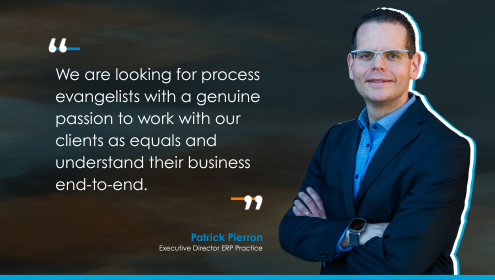
We know this sounds easier than it is. When we launched our own ERP practice, our Executive Director for that practice put it plainly: businesses that spend years customizing their backend to fit every process end up trapped in slow, expensive upgrade cycles the moment they want to change anything.
If you are still running SAP ECC, the clock is a real constraint: mainstream maintenance ends on 31 December 2027. That does not mean rip-and-replace next year. It means choosing your migration path now, and starting with the processes that can move with the least disruption.
5. Set Up Governance Before You Scale
Every agent needs an owner, a defined scope, and a way to switch it off. Without it, one misfiring agent can freeze a warehouse before anyone notices.
Picture forty agents running across five departments, and nobody can tell you which one just declined a customer’s return. That is the failure mode governance exists to prevent.
SAP’s answer is the AI Agent Hub, built on SAP LeanIX. It gives you one place to see every agent, SAP-built or otherwise, and what it is allowed to touch. SAP says 150 companies are already using it to manage more than 100,000 agents.
On the regulatory side, do not confuse two separate tracks moving through Europe. The EU’s Digital Omnibus pushed the toughest high-risk obligations under the AI Act back to December 2027. It left the transparency rules under Article 50 untouched, and those have applied since 2 August 2026. If your agent talks to a customer, that rule already applies to you today.
For the practical side of governance, our own agentic AI adoption strategy covers how we set clear no-go zones for sensitive data, and how we build in the ability to shut down a misbehaving agent without taking the rest of the business with it.
6. Adopt, Then Extend, Then Build
Resist the urge to custom-build everything. Adopt SAP’s standard Joule Assistants where they already fit your process. Extend them with your own context using Joule Studio, SAP’s tool for building and adjusting agents through both low-code and pro-code paths. Reserve custom builds for what genuinely differentiates you.
Open standards make this sequencing realistic across vendors, and they matter if you are worried about locking yourself into one supplier’s roadmap. A2A, or Agent2Agent, is an open protocol that lets AI agents from different vendors talk directly to each other. It lets a Joule agent hand off a task to a Google Cloud agent and back. MCP, or Model Context Protocol, does the same job for data: it gives an agent a standard way to read and act on information from any connected system.
Our own DOUGLAS project follows the same logic. Its AI Beauty Advisor, ANNA, only works because we connected the customer-facing chat directly into DOUGLAS’s live product catalog and each shopper’s beauty profile.
7. Graduate Autonomy and Scale
Move a process up the autonomy ladder only once the numbers prove it: accuracy, exception rate, and the KPI you set in step one, tracked over a defined period. Keep a clear way back down if something breaks.
As agents take over execution, your people’s jobs shift toward supervising exceptions and improving the process itself, not toward becoming redundant.
Treat what you spend on agents the way you already treat cloud spend. SAP and Google Cloud are both moving toward consumption-based pricing, so budget and monitor it as it grows, rather than discovering the bill after the fact.
Where SAP and Google Cloud Meet in the Middle
We wrote about the strategic logic behind the SAP, Databricks, and Google Cloud alliance when it first solved what we called the integration trilemma. Businesses previously had to choose two out of three: powerful AI, deep business context, or an open platform. What has shipped since is worth an update.
A simple rule of thumb still holds. SAP owns your business processes, your transactions, and the authorizations, meaning who is allowed to approve what, that decide who can act. Google Cloud extends your reach: non-SAP data, multimodal reasoning through Gemini (handling text, images, and voice together), and customer surfaces well beyond your own website.
Route work to whichever side actually owns the outcome, and use A2A to hand tasks between them. None of this requires picking a side. Open protocols exist precisely so you are not locked into either vendor’s roadmap.
Agentic commerce is where this shows up fastest for retail and consumer businesses. We covered the shift in buyer behavior in our article on Agentic Commerce, and the specific steps to prepare your storefront in our guide to Google’s Universal Cart.
SAP Commerce Cloud has since endorsed Google’s Universal Commerce Protocol directly, so shoppers can discover and buy products from your catalog inside the Gemini app and Google Search, not only on your own site.
What to Look for in an SAP AI Implementation Partner
Gartner calls this “agent washing”: relabeling old automation as agentic AI without the substance behind it. The firm estimates that roughly 130 vendors out of thousands making that claim can actually deliver on it. That is why the partner you choose matters as much as the platform.
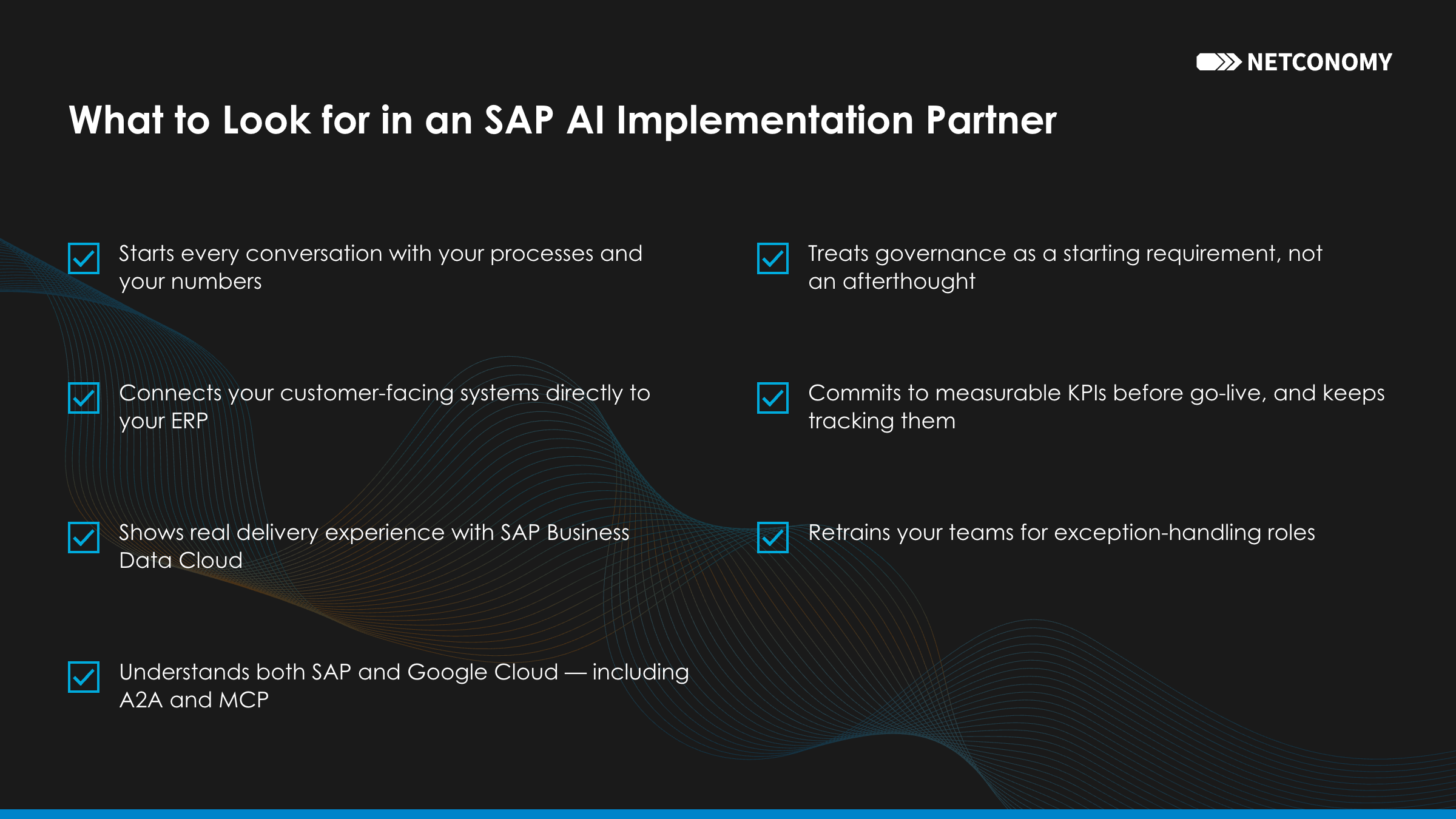
Look for one that will:
- start every conversation with your processes and your numbers
- connect your customer-facing systems to your ERP
- show real delivery experience with SAP Business Data Cloud, master data, and data products
- understand both SAP and Google Cloud, including protocols like A2A and MCP
- treat governance as a starting requirement
- commit to measurable KPIs before go-live, and keep tracking them after
- retrain your teams for exception-handling roles
Where a partner provides value is in the parts that cross team boundaries: connecting front office to back office, and ensuring governance makes sense within your actual organizational chart. That is exactly why we built our own ERP practice to sit alongside our existing SAP Customer Experience and data and AI teams, instead of running it as a separate business. Front office, meet back office: it is how we connected a customer-facing AI agent like ANNA to the live inventory and pricing data it depends on, under one roof and one team.
Autonomy Is Earned, Not Installed
None of the technology in this article does the work by itself. SAP and Google Cloud hand you the pieces: data, models, protocols, and governance tools.
Whether they add up to an autonomous enterprise still depends on the processes you pick, the data you clean up first, and the partner you trust to build it with you.
If you are not sure where your organization stands on that path, our Agentic AI Readiness Checklist is a good place to start before your first pilot. And if you would rather talk it through, our digital consulting colleagues are always ready to have a chat.
Frequently Asked Questions
What is SAP’s Autonomous Enterprise strategy?
SAP’s Autonomous Enterprise, introduced at SAP Sapphire 2026, is SAP’s strategy for moving enterprise software from systems that record data to agents that execute business decisions directly. It runs on three layers: SAP Business Data Cloud and AI Foundation for business context, Joule Studio for building and governing agents, and Joule Work as the conversational layer that coordinates them.
What are the steps to becoming an autonomous enterprise with SAP?
Becoming an autonomous enterprise takes seven steps: define your ambition and value pools, assess your readiness honestly, build your data and context foundation, get your core AI-ready, set up governance before you scale, adopt then extend then build, and graduate autonomy and scale. Most of this work happens before a single agent goes into production.
Why do most agentic AI projects fail?
Gartner predicts that more than 40% of agentic AI projects will be canceled by 2027, for three recurring reasons: rising costs, unclear business value, and weak risk controls. The models themselves are rarely the problem. Projects that skip a readiness assessment and go straight to building an agent are the most likely to end up in that 40%.
What is SAP Business Data Cloud, and why does it matter for AI agents?
SAP Business Data Cloud is SAP’s unified data platform, giving AI agents one governed map of business data and its meaning instead of a collection of disconnected tables. It now includes the Dremio data lakehouse, which lets SAP and non-SAP data coexist without migration, Prior Labs’ tabular AI models built for structured data like transaction logs, and zero-copy access to Google BigQuery through BDC Connect.
Do I need to migrate to S/4HANA before adopting AI agents?
No. You can build your data foundation and adopt agents for customer-facing and analytical processes before finishing an S/4HANA migration, for example by connecting SAP Business Data Cloud to BigQuery without moving data out of your existing core. That said, SAP ECC’s mainstream maintenance ends 31 December 2027, so a migration decision, not necessarily the migration itself, needs to happen now for any deeper, transaction-level autonomy.
How do SAP and Google Cloud work together on agentic AI?
SAP and Google Cloud divide the work rather than compete for it. SAP owns your business processes, transactions, and authorizations, while Google Cloud extends your reach through non-SAP data, multimodal Gemini models, and customer-facing surfaces like Search. Two open protocols connect them: A2A lets agents from either platform hand off tasks to each other, and MCP gives agents a standard way to read data from connected systems.
How is SAP’s Autonomous Enterprise different from a chatbot or copilot?
A chatbot or copilot assists a person who still does the work. An autonomous enterprise agent executes the process itself and escalates only the exceptions. The difference maps onto an autonomy ladder, running from AI that drafts or summarizes, through AI that recommends or acts with approval, to AI that acts independently within defined boundaries.
What should I look for in an SAP AI implementation partner?
Look for a partner who leads with your business processes rather than a product demo, connects customer-facing systems directly to your ERP, and has real delivery experience with SAP Business Data Cloud and master data. They should also speak both SAP and Google Cloud fluently, including protocols like A2A and MCP, and treat governance as a day-one requirement. Gartner estimates that only around 130 vendors, out of thousands claiming “agentic AI” capability, actually deliver it, so verified delivery experience matters more than the pitch.