The SAP Business AI Platform: Moving Beyond AI Pilots to Real Business Outcomes

In core business operations, accuracy is a necessity. As SAP SE CEO Christian Klein pointed out at SAP Sapphire, “almost right just isn’t good enough” when dealing with mission-critical enterprise processes.
While consumer-focused generative AI has proven highly capable at drafting marketing copy or summarizing customer service documents, enterprise workflows require a level of predictability that standard large language models cannot guarantee on their own.
If a customer-facing chatbot makes a minor phrasing error, the stakes are relatively low. But if an inventory-management agent miscalculates stock levels, it can disrupt an entire supply chain and directly impact a company’s bottom line. This reliability gap, paired with complex security, legal, and operational risks of generative AI, explains why many enterprise AI pilots have struggled to transition from experimental sandboxes into daily production.
To address this, SAP is focusing on bridging the gap between AI capabilities and practical business application. By consolidating its data, model orchestration, and security tools into the unified SAP Business AI Platform, the company aims to move beyond simple conversational assistants to what it calls the “Autonomous Enterprise.”
What Is the SAP Business AI Platform?
The SAP Business AI Platform is a unified, SAP-managed enterprise AI foundation that consolidates the SAP Business Technology Platform (BTP), the SAP Business Data Cloud (BDC), and SAP’s AI Foundation into a single environment.
This integrated stack represents a shift away from historically scattered AI capabilities and patchwork implementations, allowing organizations to build, run, and govern context-aware AI agents across their business landscape.
Architecturally, the platform is structured into three clean layers:
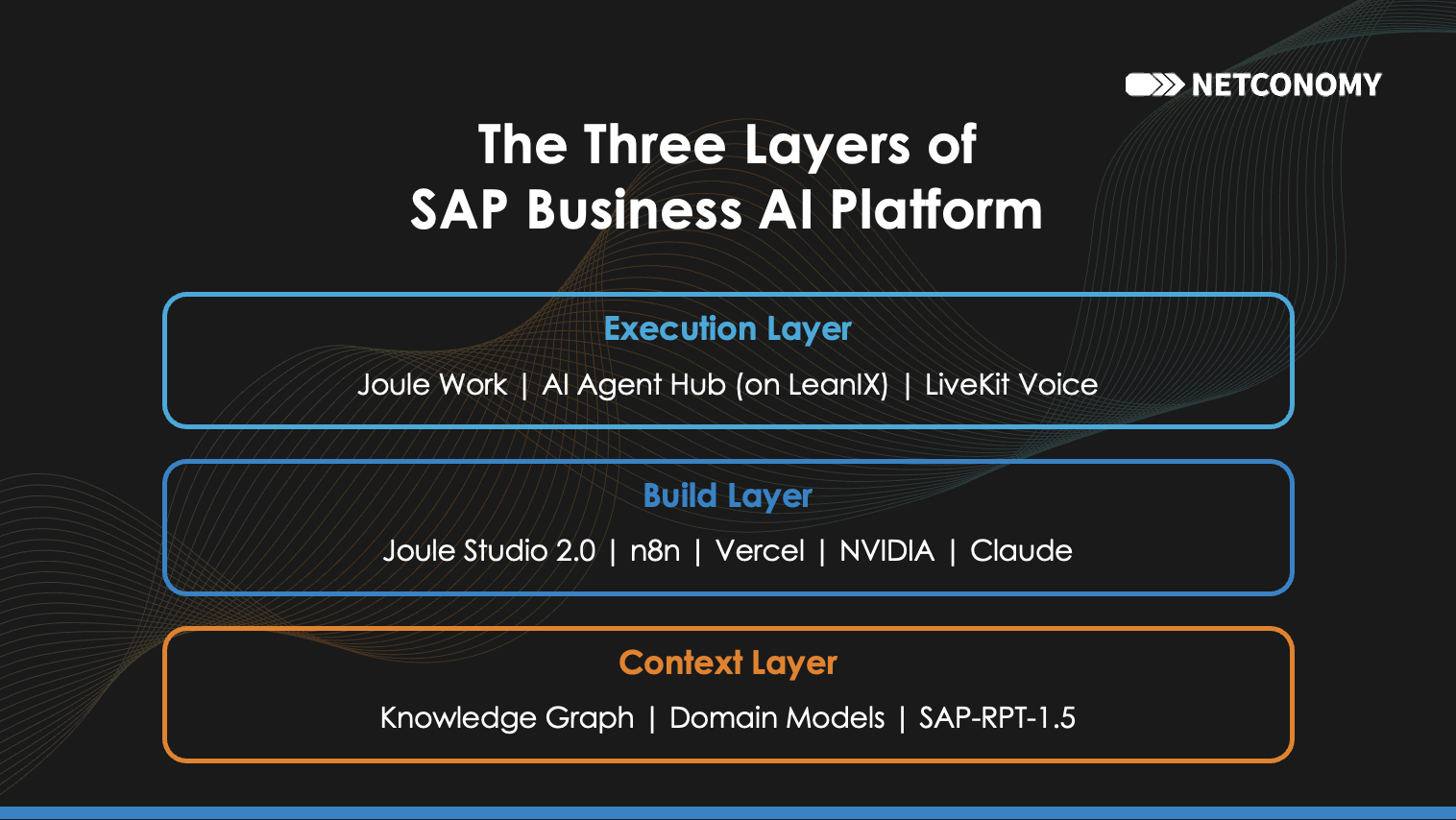
1. The Context Layer: Helping AI Understand Your Business
Standard AI tools usually fail in corporate settings because they do not understand how a business actually operates. If you ask a public AI to “fix a shipping delay,” it has no way of seeing your customer contracts, checking warehouse stock levels, or understanding how a late shipment affects your revenue.
SAP addresses this by giving the AI real-world business context through two main tools:
- The SAP Knowledge Graph: Think of this as a smart business map. Instead of looking at isolated spreadsheets, it understands how everything in your company is connected. For example, if there is a supply disruption, the AI can immediately trace exactly which customer order is affected and calculate its direct impact on your revenue.
- SAP-RPT-1.5 (Grounded in Tabular AI): Enterprise data lives in highly structured database tables, which are notoriously difficult for standard, text-focused AI models to interpret. To bridge this gap, SAP developed its own Relational Pretrained Transformer (SAP-RPT-1.5) specifically to read database columns and rows. This capability is set to be significantly accelerated by SAP’s recently announced agreement to acquire Prior Labs, a pioneer in Tabular Foundation Models. This tabular AI approach allows the platform to make instant, reliable predictions on structured data on the fly, eliminating the months of manual training and high computing costs traditionally required to deploy custom machine learning models.
2. The Build Layer: Low-Code and Pro-Code Agent Development
With Joule Studio 2.0, SAP is bridging the gap between business analysts and professional software engineers, allowing them to collaborate on designing and optimising AI agents. Rather than treating agent development as an isolated data science silo, the platform offers a balanced, two-track development environment:
- For Business Analysts (Low-Code): Non-technical teams can use Joule Studio and SAP Build to visually map out agent behaviors and loops. Following a strategic investment in the workflow automation platform n8n, SAP has embedded visual drag-and-drop orchestration directly into the build environment. Business users can easily establish automated processes, set up human-in-the-loop approval checkpoints, and create prototypes. Critically, these visual designs auto-generate clean pro-code files behind the scenes, ensuring they can be passed to IT for enterprise extension.
- For Technical Teams (Pro-Code): Your IT specialists and software engineers can take those visual prototypes and expand them with custom business logic, or build highly advanced agents from scratch. This professional pathway provides your development team with the specialized coding tools and software development kits they need to deploy custom workflows onto secure, enterprise-grade cloud servers. Crucially, this setup gives your engineers the flexibility to work with industry-standard AI development frameworks, allowing them to innovate quickly without stepping outside your company’s secure security and data compliance guardrails.
3. The Execution Layer: The Conversational Interface
The corporate user experience is shifting away from static, complex, multi-screen graphical user interfaces (GUIs). It is being replaced by Joule Work, a conversational, voice-and-text workspace. Instead of navigating through multiple legacy dashboards to close a monthly financial ledger or update a marketing segment, users state their goal in plain language. Joule then acts as the central orchestrator, mobilizing a swarm of background agents to perform the actual clicks and API calls behind the scenes.
Making Your Different Systems Work Together
While SAP’s new platform works incredibly well on its own, the reality is that most companies use tools from several different technology vendors. This fragmentation creates a major challenge: how to combine powerful AI with deep business context while keeping your platform open and flexible.
Rather than letting different software systems trap your data in new silos, the goal is to build simple, secure connections. A great example of this is the strategic SAP, Databricks, and Google Cloud alliance. This collaboration decisively bridges the gap between ecosystems. It allows your business to combine SAP’s rock-solid business tracking, Google Cloud’s advanced AI capabilities, and Databricks’ open environment for custom models—all without having to pay to copy your databases or risk your security.
The Path Forward: What This Means for Your Business
At its core, SAP’s launch of the Business AI Platform shifts the focus of AI from basic conversational tools to actual, operational business results. For enterprise leaders, this means you can finally stop running isolated AI experiments and start automating complex workflows at scale, opening doors to new revenue sources such as agentic commerce.
Instead of your employees spending hours manually resolving shipping errors, matching up purchase orders, or transferring data between systems, secure AI assistants can handle these tasks in the background under human supervision. This keeps your data safe, drastically lowers your operating costs, and frees your teams to focus on what matters most: growing the business and taking care of your customers.
However, achieving these results requires clean, well-organized data, cultural alignment, and a solid, step-by-step Agentic AI adoption strategy that fits your specific business model.
To help you take the first step, we have created a simple self-assessment tool. You can use our Agentic AI Readiness Checklist to see if your current data structure and digital systems are ready to support the next generation of enterprise AI models.
Authors and Contributors

Martin Barzauner | CEO